
Many people believe that more income means automatically a better financial life. If any person earning rises from $50,000 to $100,000, then to $150,000, and eventually to $300,000, then naturally it seem like as their financial stress should disappear. But in real life, it isn’t always happens. A person earning six times more income might still check their bank balance before buying groceries. The reason is simple that a higher income doesn’t automatically create financial security. Your spending habits, savings rate, taxes, debt, housing costs, and lifestyle can also change along with your income. And this is know as lifestyle inflation or lifestyle creep. It quietly prevents you from building wealth.
$50,000 Income: Focus on Financial Stability
When your income is around $50,000 per year, then the most important isn’t complicated investing or advanced tax planning. First of all, it is very important to create a financial cushion. Your first target should be to build an emergency fund, reduce high-interest credit card debt, and maximize the benefits of your employer’s retirement plan. One important opportunity is 401(k) employer match. If the company matches a portion of your retirement contribution, failing to contribute the required amount could be like leaving additional compensation on the table.

Lower aur moderate-income workers may be also eligible for the Saver’s credit. In 2026, the income limit for the single filers is $40,250 and $80,500 for married couples filing jointly. According to the eligibility, the credit can reach a maximum of $1,000 for individuals and $2,000 for married couples. At this income level, the simple financial habits are more important than picking the perfect stock. So, first of all, build an small emergency fund, reduce the high-interest debt and start automatically transferring your savings. Because the goal is simple: to create financial breathing room.
$100,000 Income: More Money, More Choices
Reaching a $100,000 salary feels like a major milestone. However, earning six figures does not mean that every financial problem disappears. Housing, transportation, insurance, healthcare, childcare and taxes can consume a large portion of income. This is where budgeting on a high income becomes important.
Another problem can appear: lifestyle inflation. Someone who once rented a modest apartment may start looking at expensive homes. A reliable car may be replaced with a luxury SUV. Restaurant meals can become routine instead of occasional treats. The salary increases, but so do monthly expenses.
The Federal Reserve’s 2025 household survey found that 91% of adults in households earning $100,000 or more reported that they were doing okay financially or living comfortably. At the same time, unexpected expenses and savings remain important issues across income groups.
The lesson is that high income and financial independence are not the same thing.
$150,000 Income: Taxes and Retirement Planning Matter More
Reaching a salary of $100,000 feels like a major milestone. But the six-figure income doesn’t means that all your financial problem will automatically disappear. Housing, transportation, insurance, healthcare, childcare, and taxes can consume a large portion of income. At this stage, high income budgeting also become very important. One more problem could arise here that is lifestyle inflation.
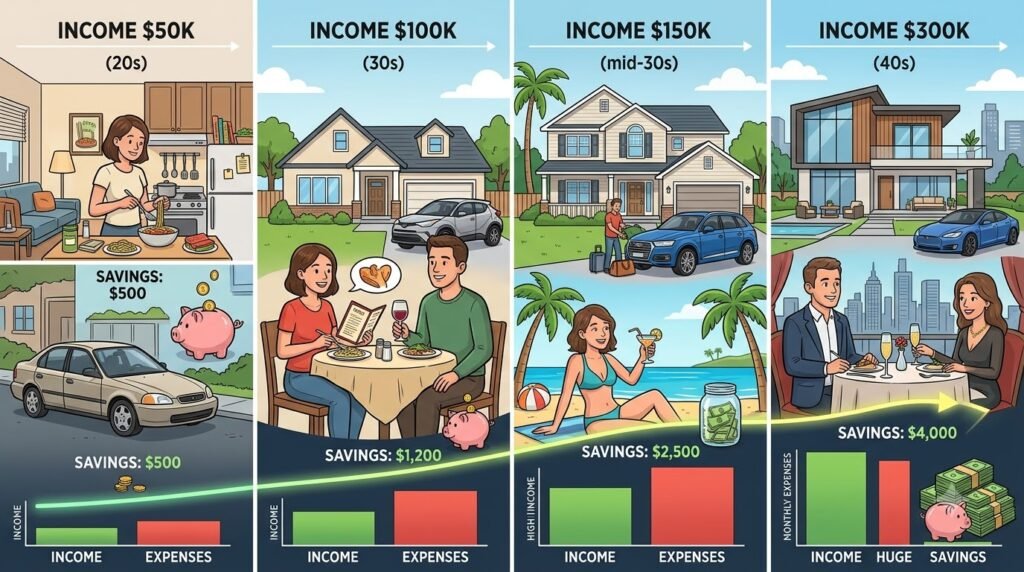
A person who previously used to lived in a simple apartment might start looking at expensive homes. A reliable car could be replaced by a luxury SUV. Dining out occasionally might become a regular monthly expense. As because when the income rises, monthly expenses also start increasing alongside it.
According to the Federal Reserve’s 2025 household survey, 91% of adults with a household income of $100,000 or more stated that their financial situation was “doing okay” or that they were “living comfortably.” However, unexpected expenses and savings remain significant concerns. So here the lesson is very simple: High income and financial independence are not the same thing.
$300,000 Income: The Lifestyle Trap Gets Bigger
Now imagine household income reaching $300,000. On paper, this sounds like financial freedom. But high earners can also experience high-income lifestyle inflation. A bigger house leads to a bigger mortgage. A better neighborhood may mean higher property taxes. A luxury vehicle brings higher insurance and maintenance costs. Two expensive vacations can quietly become four. The problem is rarely one huge purchase. It is the collection of small upgrades repeated every month for years.
Consider an additional $1,000 per month that could have been invested instead. At a hypothetical 7% annual return over 25 years, that monthly amount could grow to roughly $810,000. The actual result would depend on investment performance, fees and taxes, but the example shows the power of compound growth. This is why saving rate matters more than income alone.
The 50% Raise Rule
One simple strategy can work across different income levels: when your income increases, save or invest at least half of the increase before increasing your lifestyle.
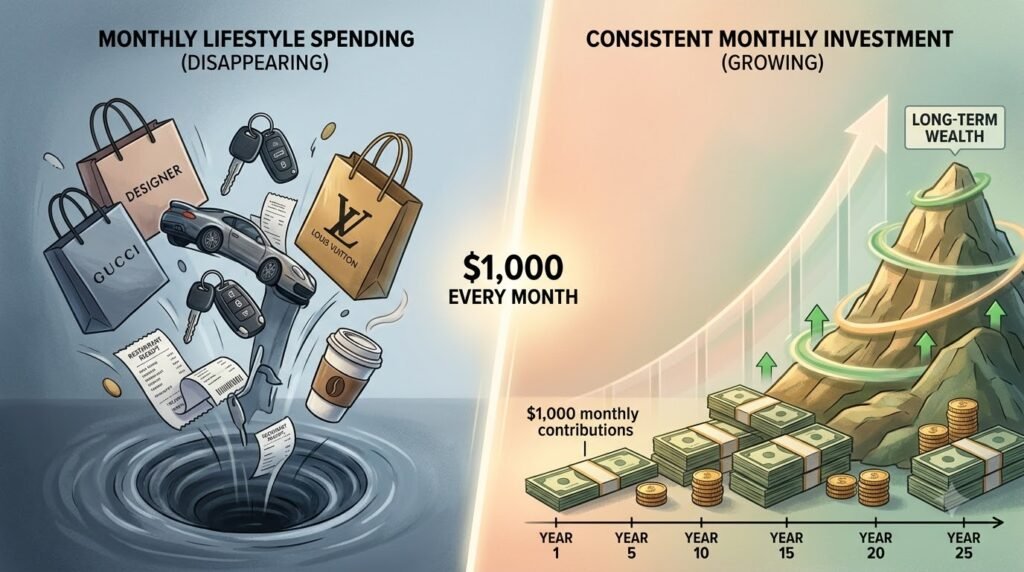
For example, if you receive a $10,000 annual raise, consider directing $5,000 toward savings, retirement or investments and using the remaining $5,000 for lifestyle improvements. This allows you to enjoy earning more without allowing your expenses to grow at exactly the same speed.
The Real Definition of Financial Success
The journey from $50,000 to $300,000 provides an important lesson. More income creates opportunities, but savings create security. For those on a lower income, an emergency fund can prevent a $400 car repair from turning into credit card debt. Disciplined saving amidst rising income can prevent lifestyle inflation from consuming every extra dollar.
According to the Federal Reserve’s latest household survey, 63% of adults said they could cover a hypothetical $400 emergency expense using cash, savings, or their next credit card statement. The survey also found that 75% of adults with a family income of $100,000 or more had savings to cover three months of expenses.
So the goal should not simply be to earn more money. The bigger goal is to make sure your savings rate grows along with your income. Whether you earn $50,000, $100,000, $150,000 or $300,000, the basic principle remains the same: control lifestyle inflation, build an emergency fund, use tax-advantaged accounts when appropriate and invest consistently. Because sometimes the difference between feeling rich and actually being financially secure is not the size of your paycheck. It is what you do with the money after it arrives.