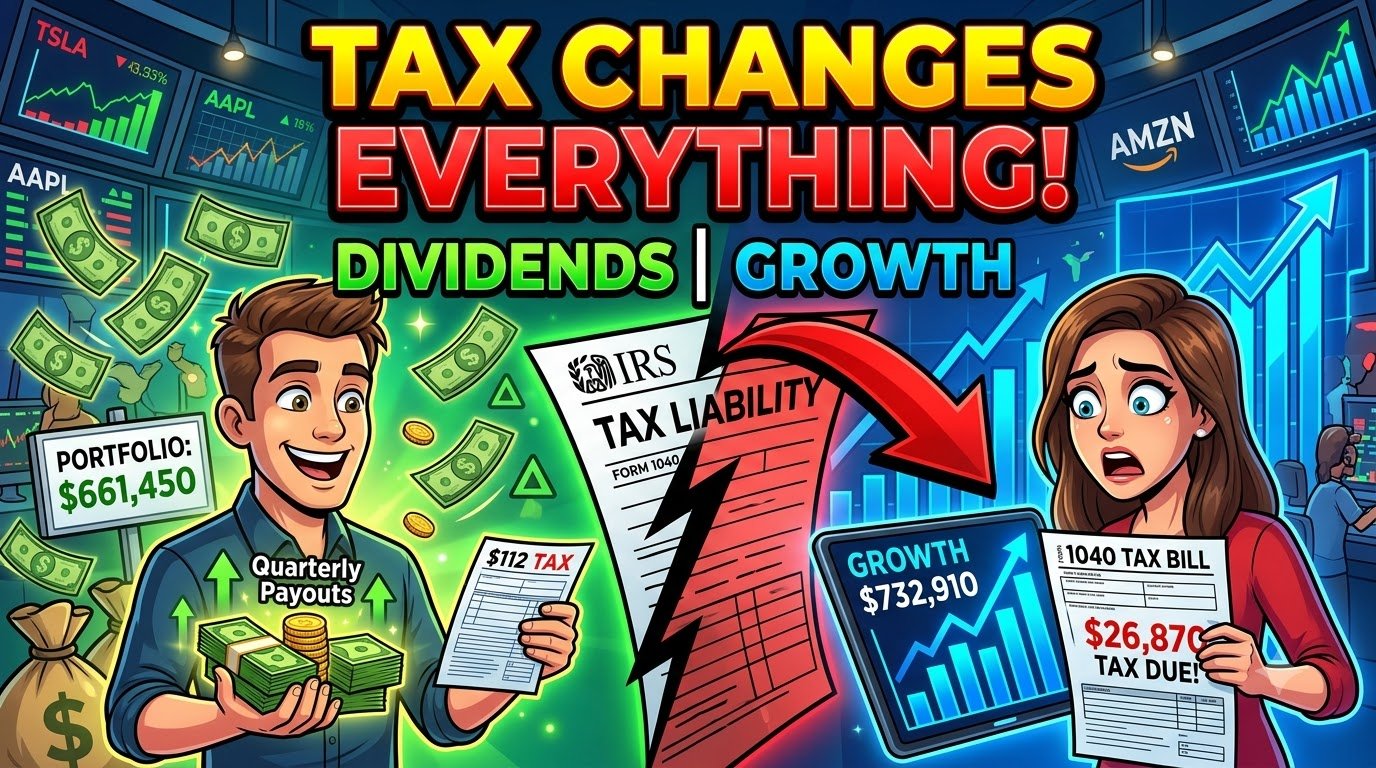
When people start investing, then a common question comes in the mind: should we invest in dividend stocks or growth stocks? which one is better. Dividend investors are more likely to be a regular cash payments, whereas growth investors prefers that companies which reinvest their profit to grow the business.
But here there is also an important factor that investors often ignore which is taxes. A simple 25 year investment example clearly shows that two people investing the same amount and earning the same average return can end up with different portfolio values. The difference can arise only when in which form the investment return is received and when the tax is paid.
Dividend Stocks vs Growth Stocks
Assume there are two people—Dana and Leo. Both of them are of 32 year and works at regional hospital at Ohio. Both have an annual income of $78,000. They each have $30,000 in savings and invest nearly $600 every month—which mean, $7,200 a year. Both of them also receive an employer match on their retirement contributions, so this investment is going directly from their regular taxable brokerage accounts.

Dana likes dividend stocks. She believes that the regular cash payment income from companies makes investing very simple and reliable. Her portfolio also includes utilities, consumer staples, banks, real estate funds, and industrial companies. But the Leo approach is little different. He invests in growth stocks, such as software, semiconductor, e-commerce and medical-device companies. These companies generally offer very low or zero dividends. Here both the strategy can create wealth, but the way of getting return in both is little different.
The Same 8% Return Can Produce Different Results
For this example, both portfolios are assumed to earn an average 8% total return per year over 25 years. Dana receives approximately:
- 4% from dividends
- 4% from price appreciation
Leo receives the entire 8% through price appreciation. Both investors reinvest their returns. However, Dana’s dividends are taxed every year in the taxable account, while Leo’s unrealized gains generally remain untaxed until he sells. The example assumes a 15% federal tax rate on qualified dividends and long-term capital gains, while state taxes are ignored.
Why Dividends Are Not Free Money
One important concept investors sometimes misunderstand is that a dividend does not automatically create additional wealth. For example, if a company has a $100 share price and pays a $1 dividend, the share price typically adjusts downward by approximately the dividend amount, all else equal.
The company is transferring part of its value to shareholders as cash. For Dana, this creates a tax event. Her $1 dividend can be taxed even if she does not need the money and immediately reinvests it. In the example, Dana’s 4% dividend yield is reduced by the 15% tax on those dividends. That means her effective return is lower than the headline 8% return because some money goes to taxes instead of remaining invested.
The Hidden Cost of Dividend Taxes
In starting phase, this difference might seem very small. If the dividend yield is 4% and tax rate is 15%, then the annual drag from dividend tax is approximately 0.6 percentage points. In this example, the calculation for the Dana is something like this: 4% price growth + 4% dividends − 0.6% dividend tax = 7.4% after-tax growth.
In case of Leo, based on simplified assumptions, the entire 8% remains within the investment. A difference of 0.6% per year might sound very small. However, when an investment compounds for over 25 years, then even a small differences can also become very significant.
What Happens During a Market Crash?
The comparison becomes more interesting during a market crash. In the example, growth stocks fall approximately 40%, while Dana’s dividend-focused portfolio falls around 22%. Dana’s portfolio also continues producing dividend income, although some companies reduce their payments. Leo faces a different psychological challenge. His portfolio has fallen sharply, and there is no dividend income providing regular cash.

This highlights an important retirement concept called sequence of returns risk. If someone needs to withdraw money during a major market decline, selling investments at depressed prices can permanently reduce the portfolio. Dividend income can potentially reduce the need to sell shares during a downturn, although dividends themselves are not guaranteed.
25-Year Investment Comparison
Under the source’s assumptions, both investors contribute the same amount and remain invested through market crashes.
| Investment Detail | Dana | Leo |
|---|---|---|
| Starting investment | $30,000 | $30,000 |
| Monthly contribution | $600 | $600 |
| Total contributions | $210,000 | $210,000 |
| Average return assumption | 8% | 8% |
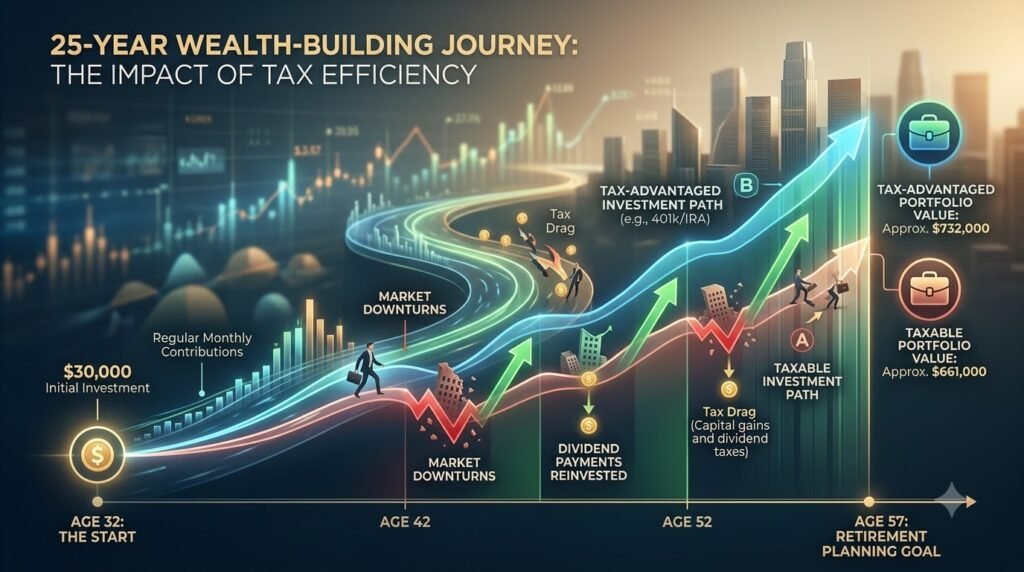
| Final portfolio value | ~$661,000 | ~$732,000 |
| Dividends received | ~$244,000 | $0 |
| Dividend taxes paid | ~$36,600 | $0 |
| Approx. final gap | ~$71,000 | — |
The source estimates that Dana receives around $244,000 in dividends over the 25 years and pays approximately $36,600 in taxes on those dividends. Leo’s portfolio reaches approximately $732,000 before considering taxes on his unrealized gains.
The Important Difference: Tax Timing
There is another side to this comparison. Leo has not escaped taxes completely. Much of his wealth is in unrealized capital gains. If he sells his investments, he may owe capital gains tax. The source estimates that if Leo sold everything at the end of the period, his tax bill could be around $78,000 under the stated assumptions.
This changes the comparison. After accounting for the hypothetical taxes, Leo’s advantage falls from approximately $71,000 to about $29,000. The key difference is tax control. Leo can generally decide when to sell and realize capital gains. Dana’s dividends create taxable income automatically when they are distributed.
What If You Invest Through a Roth IRA?
This is where the example makes an important point about tax-advantaged investment accounts. If the same investments were held in a Roth IRA under the example’s assumptions, Dana’s dividends would no longer create the annual tax drag described above.
The model therefore gives both portfolios the same 8% growth rate, resulting in approximately $732,000 for each investor. This shows that the investment account can matter as much as the investment style itself.
Dividend Stocks or Growth Stocks: What Really Matters?
In this example, the main lesson is not that the growth stocks are always better than dividend stocks. Actually, the example deliberately assumes that the total return from both strategies is 8%. In this, the focus is not on declaring a particular investment style the winner, but rather on understanding how taxes, investment accounts, tax timing, and investor behavior can affect the long-term wealth. Dividend investing can provide you a regular cash flow and help some investors stay invested during market downturns.
In growth investing, returns can remain within the investment, and the investor generally decides when to realize the gains. That’s why asking the simple question, “Are dividend stocks better or growth stocks?” does not provide the complete picture.
Final Takeaway
For a long-term investor, perhaps a better question is: “What portion of my investment return is being lost to taxes before it can compound?” In the short term, a small annual difference in taxes might seem insignificant. However, over the course of decades, the impact can be substantial due to the effect of compound growth.
Additionally, investors should also remember one thing that dividends are not guaranteed, stock prices can fall, and investment returns are uncertain. And in this example, the biggest wealth building factor is consistent investing. Dana and Leo both of them continue to invest $600 monthly for 25 years, including market downturns and this consistency is a major part of the wealth building.
The simple lesson is at the time of investment, Do not look only at dividend yield or stock price growth. Total return, taxes, the type of investment account, tax timing, and your behavior during a market crash all are also be equally important. Lastly, the question of dividend versus growth is not just about the form of the return. The amount of tax, the timing of the tax, and the duration for which your money compounds are crucial factors in long-term investing.