
There is a huge possibility that any two families have a net worth of $1 million dollars, but yet their financial lives could be completely different. One family might own a huge house, expensive cars, boat and luxury items. From outside they may appear wealthy. While another family might lives in small house, drive an old car, and quietly own index funds and a private business.
On paper both the family are wealthy but their wealth structure is totally different. And this difference can determine how fast their money can grows in the future.
Your Net Worth Is Not the Whole Story
The simple meaning of Net worth is your total assets minus your total debt. But by looking only at the final number might cause you to miss an important question: where is your money actually invested. Just assume a family has $1 million, but their majority wealth is locked in a house, cars and personal possessions while the second family also has $1 million, but their wealth is invested in stocks, index funds and busines.
When the stock market and business grow, then the second family will have more such money that potentially work for them. The source cites the example of two fictional families living on the same street. For one family, around 65% of their wealth is tied up in their home and personal possessions, whereas for the other family, about 72% of their wealth is invested in stocks and business. So, here the lesson is very simple: It is not just the amount of wealth you possess that matters; in which form your wealth is held is also very important.
Wealthy People Own Productive Assets
There is a major difference between the Wealthy households and ordinary households—the ownership of stocks and businesses. According to the source, a significant portion of the wealth held by America’s wealthiest 0.1% of households is in stocks and private businesses, whereas the share of real estate is comparatively smaller.
The opposite pattern is more commonly observed in lower-wealth households, where a large portion of wealth is tied up in homes and personal property. But why this difference is so important? It’s just because productive assets can potentially generates income and it’s value also increases with the time.
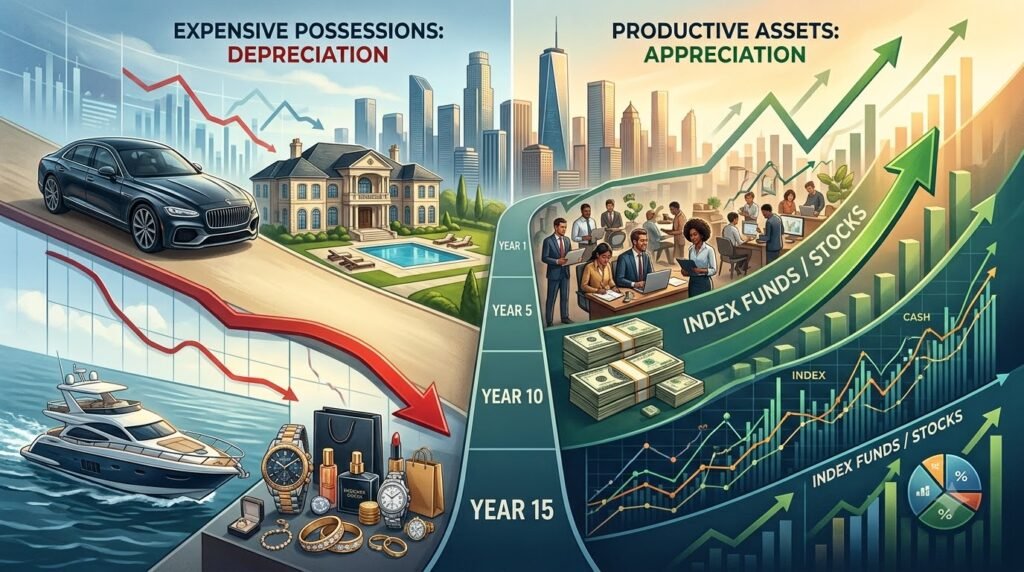
For example, an index fund can potentially grow based on the growth of the companies where it is invested. A business can generate profits. Value of house also appreciate with over time, but its primary purpose is generally to provide a place to live. This doesn’t means that buying a house is a financial bad decision. Homeownership can be an important part of financial security. So here the important key point is that your home shouldn’t become your entire wealth strategy.
Expensive Cars Can Work Against Wealth Building
Cars, boats, and other luxury purchases can make someone look rich without actually making them wealthier. A new vehicle generally loses value over time. If it is financed, monthly payments also reduce the amount of money available for investing. The source gives an example of a family spending around $110,000 on vehicles and a boat, costing roughly $1,900 per month in payments.
That money could instead be directed toward:
- Index funds
- Retirement accounts
- Emergency savings
- Business ownership
- Paying down high-interest debt
This is one of the most important wealth building habits: don’t allow lifestyle expenses to consume the money that could be compounding for decades.
Cash Is Also Part of a Wealth Strategy
It is easy to assume that wealthy people keep every dollar invested. But that isn’t necessarily true. The source highlights research showing that millionaires can keep a significant portion of their portfolios in cash. The reason is not that cash produces huge returns. It provides liquidity. Cash can help investors avoid selling stocks during a market crash or an emergency.
This is an important principle for financial planning: Liquidity gives you the ability to wait. If you have enough emergency savings, you may not be forced to sell investments when prices are falling. For most people, this simply means maintaining a sensible emergency fund before taking large investment risks.
Index Funds Can Be a Simple Wealth-Building Tool
You don’t necessarily need complicated investments to build long-term wealth. The families described in the source demonstrate how ordinary investors can build significant wealth through index funds and consistent investing. Index funds are popular because they provide broad exposure to many companies rather than requiring an investor to pick individual stocks.
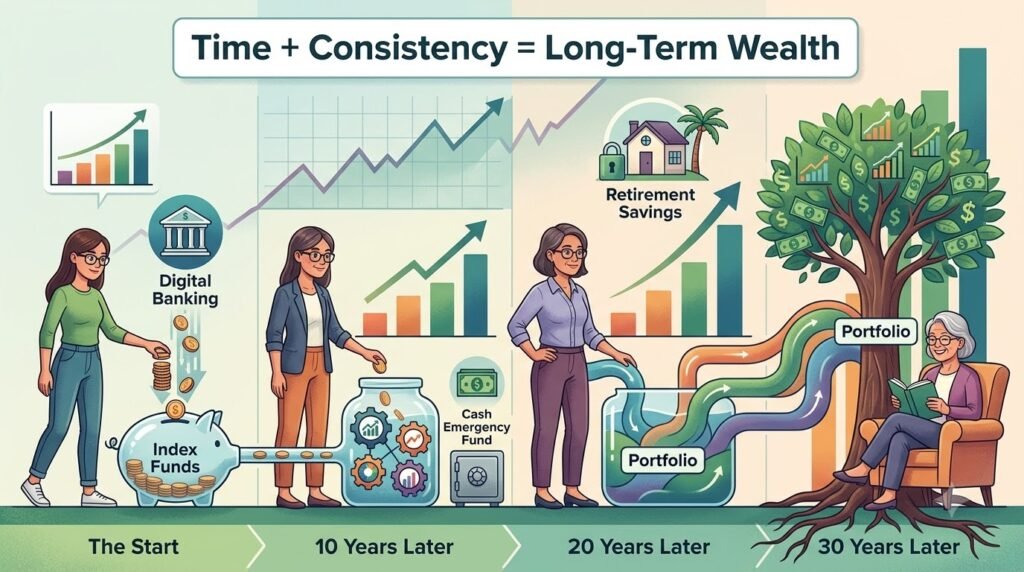
The bigger advantage may be consistency. For example, investing $500 every month and earning an average 7% annual return could potentially grow to roughly $610,000 over 30 years and around $1.3 million over 40 years, according to the example in the source. The numbers are not guaranteed, but they demonstrate the power of compound interest. Time can be more important than finding the perfect investment.
Be Careful With Illiquid Investments
Private equity and private credit are often associated with wealthy investors. But higher potential returns can come with important trade-offs. The source discusses private equity, where money may remain invested for long periods and fees can be significant. It also describes private credit funds where investors may face restrictions on withdrawals during periods of heavy redemption requests.
This highlights an important investing rule:
Don’t sacrifice liquidity just because an investment sounds exclusive.
If you might need the money soon, an investment that makes withdrawals difficult may not be appropriate for that portion of your savings.
The Real Secret Is the Order of Your Financial Decisions
Building wealth is not necessarily about looking rich. It is about the order in which you use your money. Instead of: Earn → Spend → Invest what remains, a stronger long-term habit can be: Earn → Save/Invest → Spend what remains, that simple change can dramatically affect your financial future.
The goal isn’t to avoid every enjoyable purchase. It is to make sure lifestyle spending doesn’t continuously consume the money that could become future wealth.
Final Thoughts
The biggest simple lesson of this example is that wealth is created by ownership not by appearance. A million dollar house, expensive car and boat might show someone wealthy. But stocks, index funds, businesses, cash reserves and other productive assets can play a completely different role in building long-term financial security.
To apply these ideas, you don’t need to be ultra rich investor. Just start from the basic: Build an emergency fund. Invest consistently. Avoid unnecessary debt. Refrain from unnecessary spending on depreciating assets. Give your long-term investments time to grow. And also protect your liquidity. Over the course of decades, these boring-looking financial decisions can have a far greater impact on your wealth than simply trying to look wealthy today.