
Most of the people see their wealth in term of net worth, investments, stocks, property and retirement savings, but the financial health is a another important part that people often overlook as cash and liquidity. Imagine two people having a net worth of $300,000 wealth. On paper, both have the same financial situation but one person has $30,000 available in cash, while the other has only $10,000 in cash, the remaining money tied up in investments. And in certain some condition, if both lose their job, then their experiences could be completely different.
That’s why cash reserves, emergency savings and financial liquidity are so important. The true value of cash does not always lie in the returns it generates; sometimes, its greatest benefit is that it gives you the time and freedom to make better financial decisions.
Cash Gives You Financial Breathing Room
Imagine a person having a wealth of $300,000, but he has very less cash immediately available. His majority of money is invested in the form of stocks, retirement accounts or home equity. But suddenly something unexpected happens. His car broke down and needs a $4,200 repairing cost. Now he left with only some option: use of the credit card, taking out a loan, or selling investments.
The problem isn’t that he lack wealth, the issue is that his wealth isn’t immediately accessible. This is where the role of emergency fund become more important. An emergency fund is those money which we set aside to cover unexpected expenses, job loss, medical costs, major repairs, and other financial emergencies. One of the most common approach is to maintain an emergency fund covering approximately 3–6 months of essential expenses. However, the actual amount depends on your income stability, expenses, and personal situation.
Emergency Savings Can Protect Your Investments
A major benefit of maintaining a cash reserve is that you may be less likely to need to sell your investments during a market downturn. Imagine the stock market drops by 27% and, at the same time, you lose your job. If you have a sufficient amount of emergency saving, then you can be able to manage your mortgage, groceries and other essential expenses for next some months. But if your cash reserve is very low, you might be forced to sell stocks while the market is down.
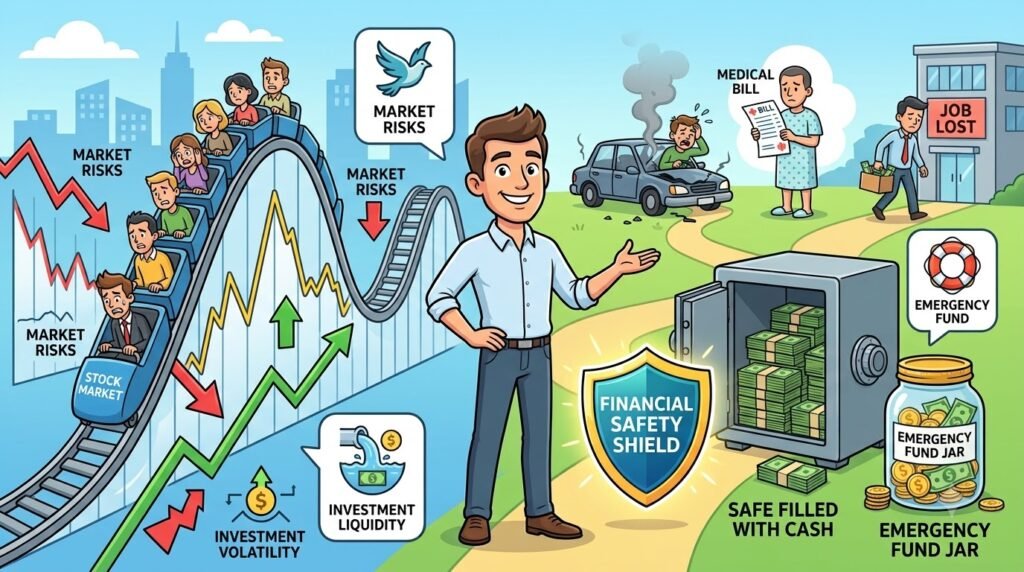
And this where the problem arises. If you sell your investment during the market crash, then a temporary market crash can convert into a permanent financial loss. That’s the reason, cash reserves are an important part of financial planning. The main purpose long-term investments is for the long-term wealth creation, whereas the purpose of emergency savings is to handle short-term financial problems.
How Much Emergency Fund Do You Need?
There is no single emergency fund amount that works for everyone. A simple way to calculate your emergency savings goal is to look at your essential monthly expenses. For example, if your essential expenses are $5,000 per month:
| Emergency Fund | Cash Needed |
|---|---|
| 3 months | $15,000 |
| 6 months | $30,000 |
| 9 months | $45,000 |
| 12 months | $60,000 |
These numbers are not strict rules. They represent different amounts of financial runway. If you have a stable job, low expenses, and a dual-income household, you might not need a very large cash reserve. However, if you are self-employed, have unpredictable income or dependents, or work in an unstable industry, a larger cash reserve could be useful.
Cash Can Give You the Power to Say No
This may be the most underrated benefit of having money available. Suppose you lose your job and immediately receive an offer paying $78,000, compared with your previous $91,000 salary. If you have almost no savings, you may feel forced to accept it. But if you have enough liquid savings, you may have the ability to wait for a better opportunity. That is the hidden value of cash. Cash can give you the ability to say: “Not yet.”
You can wait for another interview, search for a better job, negotiate your salary, or avoid accepting a decision that could negatively affect your finances for years. In this sense, financial freedom is not only about having more money. It is also about having more choices.
But Keeping Too Much Cash Has a Cost
This does not mean you should keep all your money in a savings account. Cash has disadvantages too. Inflation can reduce purchasing power over time, while long-term investments such as diversified stocks have greater potential for growth. Keeping retirement money in cash for decades could mean missing out on compound growth.
The goal, therefore, is not to maximize cash. The goal is to keep enough cash for your short-term needs while allowing long-term money to remain invested. Think of your money as having different jobs:
- Emergency savings: protects you from unexpected expenses.
- Short-term savings: pays for upcoming goals.
- Long-term investments: builds wealth over many years.
- Retirement savings: supports your future lifestyle.
Giving every dollar the same job can create problems.
Cash Also Creates Opportunity
Cash is not only useful during emergencies. It can also give investors flexibility when opportunities appear. Maybe an attractive investment becomes available. Perhaps you find a business opportunity or need to make an important purchase. If all your money is already committed, you may have to watch the opportunity disappear. This is sometimes described as keeping “dry powder”—money that is available to deploy when needed.
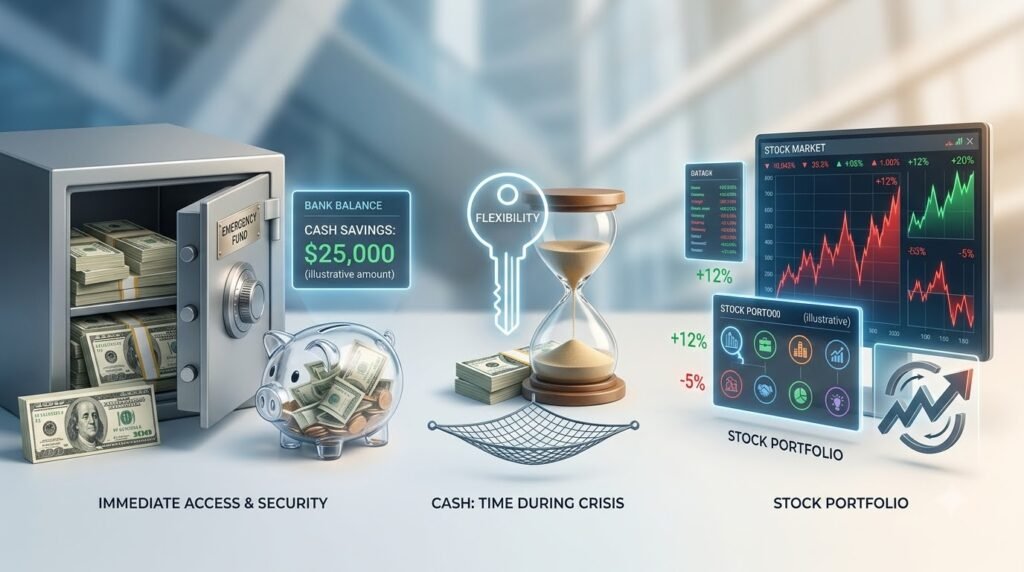
However, this does not mean trying to predict every stock market crash or keeping half of your portfolio in cash. It simply means maintaining enough liquidity to avoid becoming financially trapped.
The Real Meaning of Financial Wealth
A high net worth does not automatically mean strong financial security. Two people can have the same $300,000 net worth but completely different financial positions. One may have $270,000 invested and only $10,000 available in cash. Another may have $230,000 invested and $30,000 in cash.
Both have similar total wealth, but the second person enjoys greater financial flexibility. In the event of a job loss, an unexpected expense, or a market crash, that additional liquidity can help the person make better decisions.
Final Thoughts
The real power of cash isn’t only just to generate a power highest investment return. Cash can give you sufficient time to find a better job, to handles emergencies, and avoid selling your investments during a market crash. And the most important things is cash can give you the freedom to make a good decisions rather than acting out of panic. A strong financial plan doesn’t mean to between cash and investments.
Your long-term money should have an opportunity to grow. Your emergency savings should provide protection. And your liquid cash should give you the freedom to handle uncertainty.
Ultimately, the goal is simple: have enough cash so that short-term problems do not force you to damage your long-term financial future. That may be one of the most valuable forms of wealth you can have.
Good