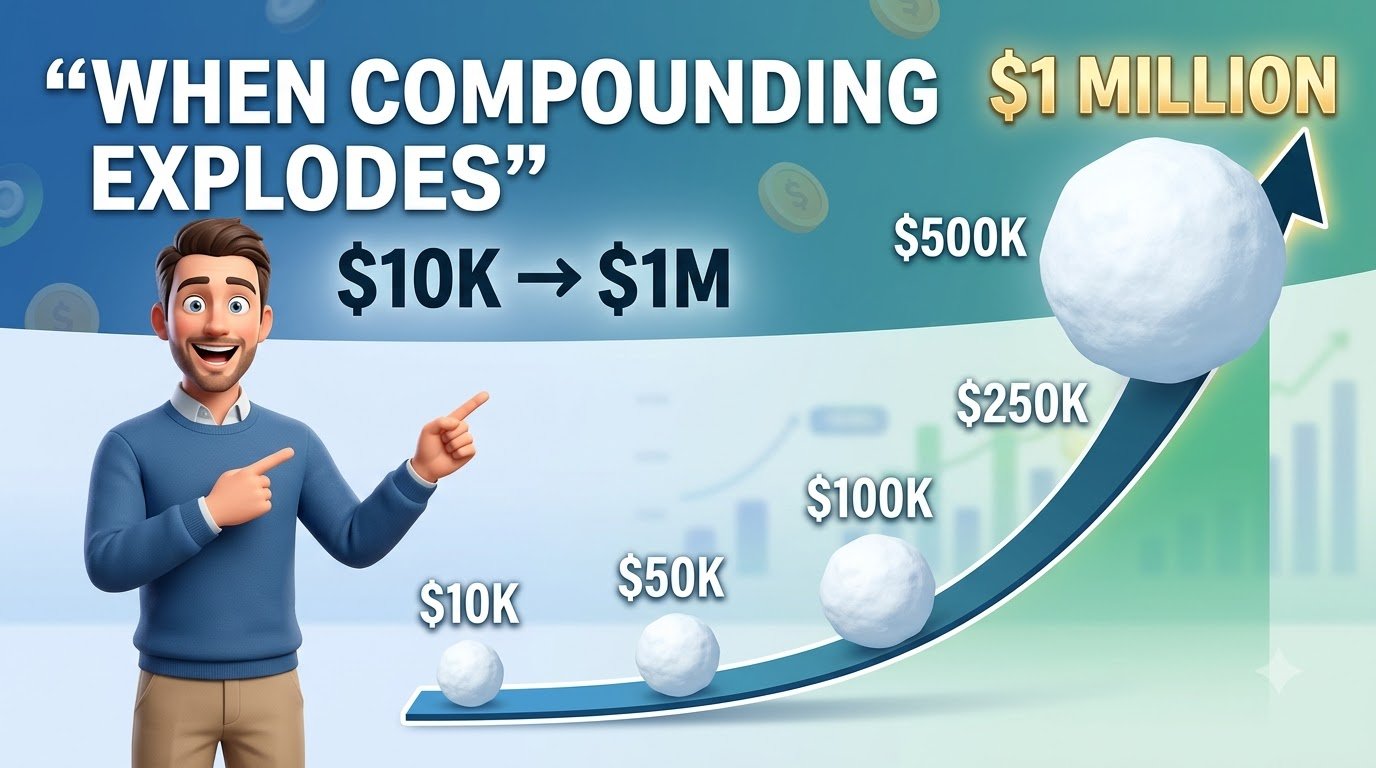
Many investors hear about the compound interest and compound growth, as they believe this is the magical formula for wealth creation.But in the starting years, compounding doesn’t feel that much exciting and could be surprisingly slow. Just imagine an investor name Alex. He has $10,000 invested and if we hypothetically assume 7% annual return then in 1 year his portfolio will grow with $700. If Alex is also investing $500 every month, he will contributes $6,000 of his own money in a year. At this stage, Alex’s own contribution clearly plays the most important role in the portfolio’s growth.
However, as the investment portfolio grows, situation are going to change completely. A 7% return on $50,000 amounts to approximately $3,500. On $100,000, that same 7% becomes around $7,000. On $250,000, it is approximately $17,500. On $500,000, it is around $35,000. And on $1 million portfolio, that same 7% could amount to approximately $70,000. The percentage just remain the same. The only difference is how much amount of capital invested behind that percentage.
Why the First $10,000 Can Feel So Slow
Psychologically the starting phase of investing could be very difficult. If you have $10,000 of investment portfolio, with this even a good investment return may not look impressive. Hypothetically, with 7% return, you get an growth of just around $700 annually. But if the investor invest $500 monthly, the he could add upto $6000 annually. That’s why investors sometimes though that the compound interest is not working. But actually it is working but only the issue is simply that the starting capital is relatively small.
Regular investing, saving, and consistent play an very important role in the early stages of wealth building. As the portfolio grows, the contribution of investment returns becomes increasingly significant. That is why consistency is vital in long-term investing.
The $50,000 Investment Milestone
The things becomes more interesting when the portfolio reaches $50,000, then the effect of compounding become more noticeable. Hypothetically at 7% of annual return approximately give you $3,500 of annual growth. The investor might still be adding more money to the portfolio themselves, but the investment account also starts making a meaningful contribution.
This is the stage where investors should avoid making the emotional decision, When the investment account begins to feel more important, then there is a chance that the investor might thought too much on market crashes, expensive stocks, or the “next big opportunity. But the long-term successful investing often depends on the strategy like diversification, low costs, regular saving and discipline.
Why $100,000 Is Such an Important Investing Milestone
The first $100,000 is often considered an important financial milestone, and there is a mathematical reason behind it. At a hypothetical 7% return, a $100,000 portfolio could generate approximately $7,000 in one year. If the investor contributes $6,000 annually, the portfolio could now potentially generate more growth than the investor is personally adding. This is an important change.
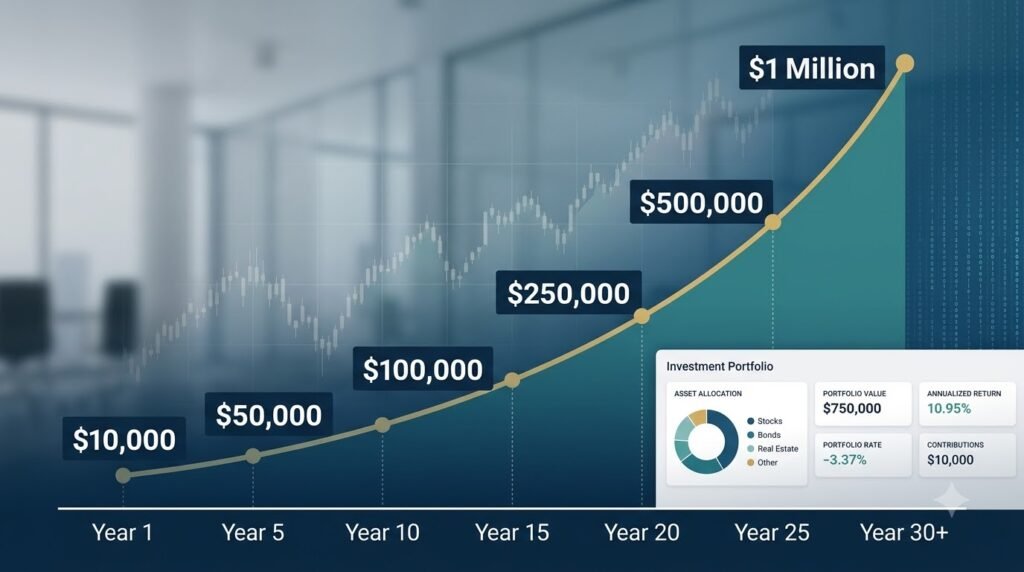
The portfolio has started to become a contributor to its own growth. There is no special button that gets activated at $100,000. The market does not suddenly become more generous. Instead, the same percentage is being applied to a much larger amount of capital. That is the basic power of compound investing.
From $100K to $250K: When Growth Becomes Noticeable
After reaching $100,000, the next stages can become increasingly interesting.
Consider a hypothetical 7% annual return:
| Portfolio Size | 7% Hypothetical Growth |
|---|---|
| $10,000 | $700 |
| $50,000 | $3,500 |
| $100,000 | $7,000 |
| $250,000 | $17,500 |
| $500,000 | $35,000 |
| $1,000,000 | $70,000 |
These figures show why portfolio size matters so much in compound growth. At $250,000, a 7% hypothetical return represents around $17,500. That is no longer a small number for most households. The investor begins to realize that future wealth does not have to come entirely from a paycheck. Some of it can come from the capital already invested.
What Happens at $500,000?
At $500,000, compounding becomes much more powerful—but market volatility also becomes more noticeable. A hypothetical 7% return would equal approximately $35,000. But the same percentage works in both directions. A 10% market decline on a $500,000 portfolio would mean a temporary decline of about $50,000.
This is an important lesson about investing: larger portfolios can produce larger gains, but they can also experience larger dollar losses during market downturns. That is why investors need a suitable asset allocation, diversification and a long-term investment strategy rather than reacting emotionally to every market move.
The $1 Million Portfolio: When Percentages Become Real Money
A $1 million investment portfolio is a major financial milestone, but the mathematics are even more interesting. At a hypothetical 7% annual return, $1 million could generate approximately $70,000 in a year.

Now look at smaller percentage differences.
- 0.5% of $1 million = $5,000
- 1% of $1 million = $10,000
- 2% of $1 million = $20,000
- 7% of $1 million = $70,000
This is why investment fees become increasingly important as a portfolio grows. A seemingly small percentage can represent thousands of dollars when applied to a large investment account.
The Real Secret of Compound Growth
Here one of the most important lesson is that compounding does not suddenly become powerful at $1 million. It was already at work at $10,000 and $50,000. Its impact became noticeable at $100,000, and it grew even more powerful at $250,000 and $500,000. The only difference is of capital. The larger the capital invested, the greater the dollar impact a given percentage return can generate.
This is why the early years of investing can feel frustrating. Investors put in money consistently but may not see dramatic results immediately. The reward comes from allowing those contributions and returns to remain invested for a long period. According to sources, contributions play a greater role in the early stages of wealth building, whereas investment returns become increasingly important in the later stages.
Final Thoughts
If your portfolio currently has $10,000, then this doesn’t means that you are failing, it simply means you are in the early process. Investments can start making a meaningful contribution once your portfolio reaches $50,000. At $10,000, the potential growth of your portfolio can be comparable to your annual contribution. At $250,000 and $500,000, the dollar impact of market returns becomes even more noticeable. And with a $1 million portfolio, the difference of just 1% can amount to $10,000.
The real power of compound interest does not lie in some magical investment. The real power lies in building capital, investing regularly, controlling costs, staying diversified, and remaining invested in the market for a sufficient amount of time.
The first dollars build the foundation. The middle dollars make the growth noticeable. Eventually, the capital you have accumulated can become powerful enough that ordinary percentages create extraordinary dollar amounts. This is the point where compound growth stops feeling like just a financial concept—and starts feeling like a powerful wealth-building machine.