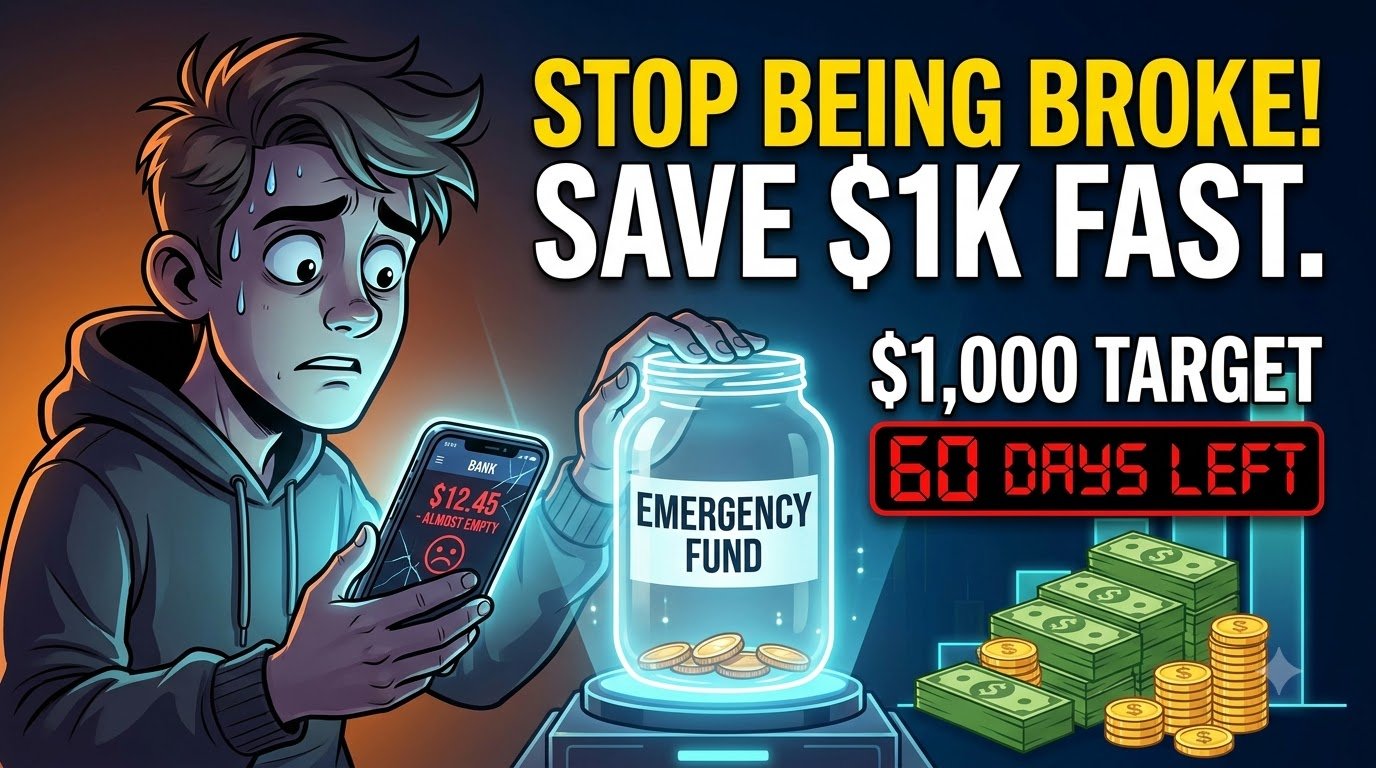
Imagine your car suddenly needs a $600 repair. One normal person pays his bills from his savings and continue to live like that. While on the other hand, another puts the same repair cost on the credit card and spends the some next year easily paying it back. The difference is not always the income. It could be having an emergency fund. If your saving accounts has $50, $100 or a few some dollars, then it is impossible to build an emergency saving fund.
Normally financial experts generally advice that you must have a emergency fund equal to 3 to 6 months of expenses, because this is good for the long-term goal, but if you are already living paycheck to paycheck then this could be feel little unrealistic. So its better first to build an emergency fund of $500 to $1,000.
Why an Emergency Fund Matters
Emergency fund are basically those funds which you have kept aside for unexpected and necessary expenses like:
- Car repair
- Medical bill
- Urgent home repair
- Important appliance replacement
- Temporary income loss
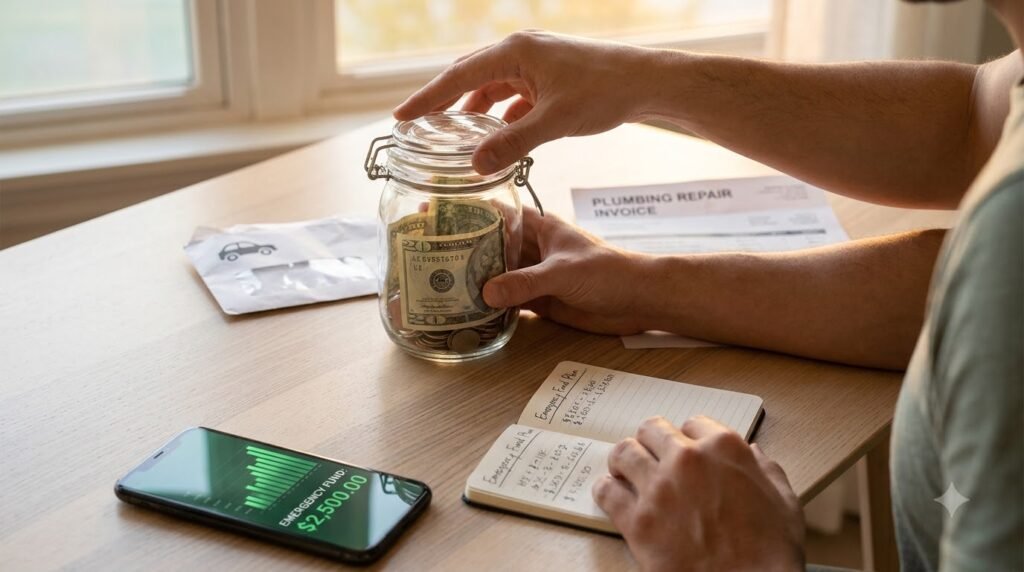
The main purpose of Emergency fund is not to prevent the emergencies as because unexpected problems will continue to arise in life just like your car could break down, refrigerator might suddenly stop working or may be an unexpected problems can rise. So the main goal of the emergency fund is to ensure that your any bad day doesn’t turn into an financial emergency.
Step 1: Track Every Dollar for 7 Days
If you want to save fast $1000, the first of all check where all your money is actually going. For the next 7 days, note down all the expenses that include rent, groceries, transportation, subscriptions, food delivery, coffee, online shopping and even small purchases.
Sometimes an expense of $10 or $15 doesn’t feel that much important but if such expenses occur multiple times in week, then they could add upto a substantial amount by the end of the month. For example you might discover that you have unused subscriptions, are paying high delivery fees, or are frequently making unnecessary purchases. So the goal isn’t to change your life style completely, the goal is to identify where money is leaking away.
Step 2: Cut Expenses You Don’t Really Need
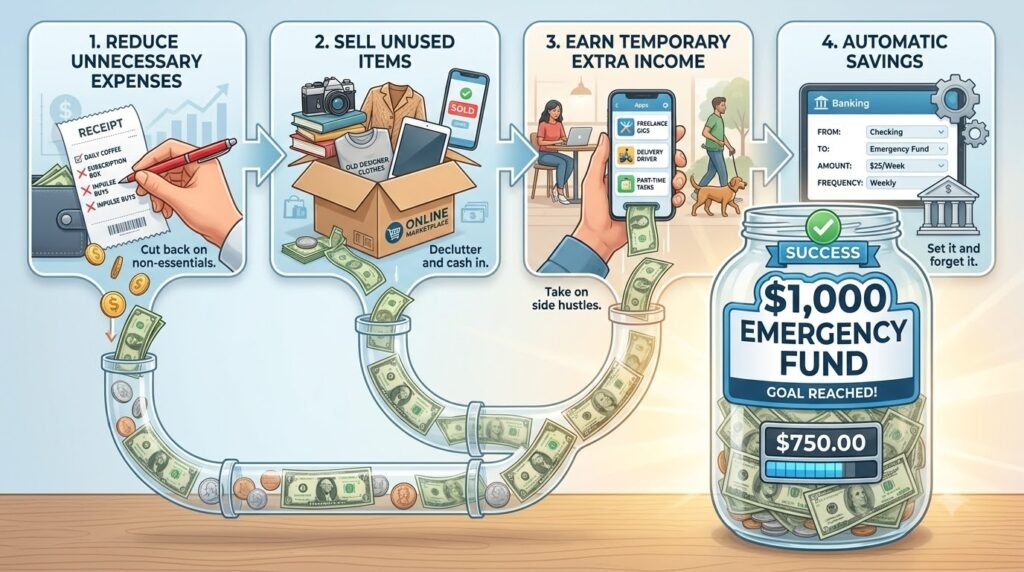
Once you know where your money goes, look for expenses you can reduce. Suppose you discover that you can save $180 over the next two months by cancelling unused subscriptions, reducing delivery orders and controlling unnecessary spending. If you already have $87, that immediately takes your emergency savings to $267.
The important lesson is that you don’t need to find $1,000 from one place. You can build your emergency fund from several smaller sources.
Step 3: Sell Things You Don’t Use
The next way to save $1,000 fast is to look around your home. Do you have an old tablet, unused furniture, kitchen appliances, electronics, clothes or other items that you rarely use? Selling unused items can create quick cash without increasing your monthly expenses.
In the example from the source, Nicole sells unused items and earns $250. Her emergency fund increases from $267 to $517. Crossing $500 is important because a small emergency may no longer require a credit card.
Step 4: Find Temporary Extra Income
Cutting expenses has a limit. Eventually, you need another way to increase your cash flow. For the next few weeks, consider temporary ways to earn extra money.
You could:
- Work overtime
- Take extra shifts
- Do freelance work
- Tutor someone
- Drive or deliver
- Sell unused items
- Take a short-term weekend job
The goal is not to create a second career. It is simply to create a temporary income boost while building your emergency savings. Even an additional $200–$300 can make a major difference.
Step 5: Automate Your Emergency Savings
Many people rely solely on willpower to save money. On every payday, they think, “This time, I’ll transfer $50 or $100 into savings.” But then, an unexpected expense pops up, and the saving doesn’t happen. That’s why setting up an automatic savings plan is a better approach Open a separate savings account and set up an automatic transfer for after payday. You can start with $40, $60, or $100—the exact amount will depend on your cash flow.
Consistency is the most important thing. It is also useful to keep your emergency fund separate from your everyday spending account. This ensures you don’t accidentally mistake your emergency savings for spending money.
Step 6: Know When to Use Your Emergency Fund
An emergency fund is not supposed to sit untouched forever. If your car needs an essential $94 repair, using $94 from your emergency fund is not failure. That is exactly why the money exists. A simple test is:
Was the expense unexpected? Is it necessary? And would paying for it seriously damage your normal cash flow? If the answer is yes, your emergency fund may be appropriate. After using the money, simply rebuild the fund.
How to Reach $1,000 in 60 Days
You don’t necessarily need one huge saving strategy. You can combine multiple methods:
| Strategy | Example Amount |
|---|---|
| Reduce unnecessary spending | $180 |
| Sell unused items | $250 |
| Temporary extra income | $250 |
| Automatic savings | $160+ |
| Starting savings | Existing balance |
This is the key idea: assemble the $1,000 instead of trying to find it all at once. Ask yourself four questions:
- What spending can I stop leaking?
- What can I sell?
- What can I temporarily earn?
- What can I automatically save?
These questions make a large financial goal feel much more manageable.
What Happens After You Save $1,000?
Your first $1,000 isn’t the finish line, it is the financial protection of your first layer. After reaching $1000, your next goal could be covering one month of essential expenses. In the long term, depending on your income stability and personal situation, you can build an emergency fund covering three to six months of essential expenses. However, the most important thing isn’t the amount itself, but the habit of saving. You don’t need to get rich in 60 days; you simply need to become a bit stronger financially.
An emergency fund does not make emergencies cheaper. It prevents an emergency from spreading into the rest of your financial life. The next time a $600 bill arrives, you want to be able to pay it, rebuild your savings and continue with your life—without creating a new credit card balance.
That is the real purpose of an emergency fund: not wealth, but financial breathing room.
Very Informative….