
Have you ever experience something like this when you buy an expensive item and then suddenly felt that everything around it look old or cheaper? Let’s assume you bought a new smartphone and then you felt that the older phone case doesn’t look good, you need a new one and after that a new wireless earbuds, charger, and other accessories. Or perhaps you bought a new car and just after that you felt that your old clothes, furniture, watch, or even vacations is no longer good enough according to your standard. And this is not just a simple poor money management or bad spending habits, There is a psychological pattern behind this which is known as Diderot Effect .
Diderot Effect explains that how a single purchase can trigger a chain reaction of additional spending. It slowly turn a $500 purchase into a $1,000 or $2,000 spending spree without even you realizing it. Many researchers and consumer-behavior experts have connected the effect with overconsumption, identity, materialism, and impulsive buying.
What Is the Diderot Effect?
The Diderot Effect happens when you buy a new product and just after that you start feeling that your other existing possessions outdated, mismatched or inadequate. For example imagine you just bought a $1,200 premium smartphone. Your original plan is just to buy that premium phone, but after bringing it home, your old charging cable suddenly looks cheap. You decide to buy a new charger. Then your old phone case does not match the new phone. So you purchase another case. Now your older wired headphones are also no longer remain that convenient, so you buy a new wireless earbuds. Suddenly, a $1,200 purchase has created an additional hundreds of dollar spending.
The most important point is that you doesn’t feel necessary all these products before buying the phone, but once you make the purchase, it will changes your perception as way you viewed everything else.
The Story Behind the Diderot Effect
The name and idea of Diderot effect comes from Denis Diderot, an 18th-century French philosopher and co-creator of the Encyclopedic. Diderot once received an expensive scarlet dressing gown. But instead of simply enjoying the new robe, he began noticing his how old and unattractive his other belongings looks next to the new one. His desk looks poorer, his rug looks worn. After that his chairs and decorations are also no longer seemed match to the standard of the robe. In this way, One purchase created a desire list for more purchases.
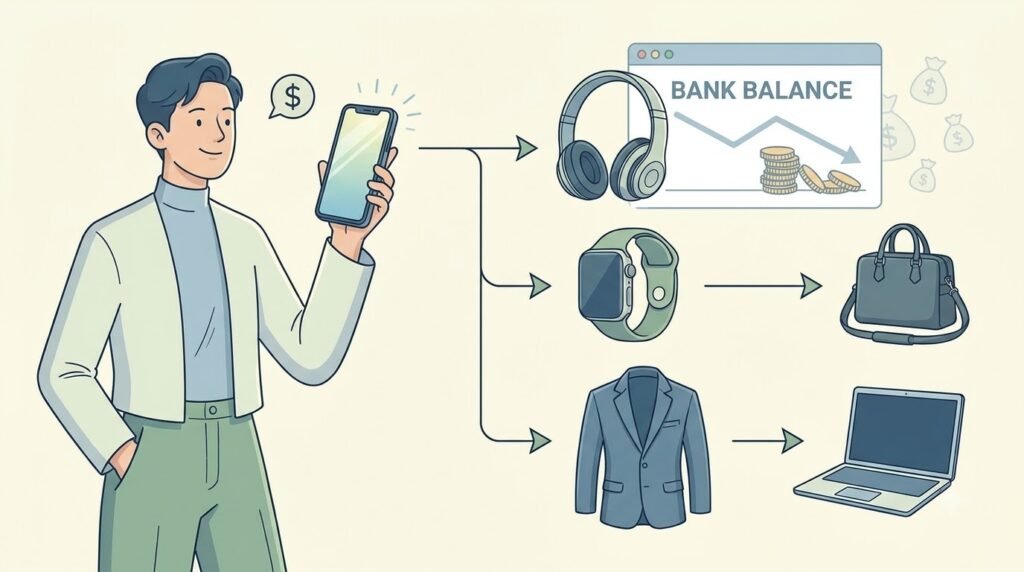
Eventually, he had to replaced a lot of things around him and this experience became the basis for what is now called the Diderot Effect. In simple words, we can say that a new possession can change the way how you see your existing possessions.
Why Do We Keep Spending More?
One major reason is identity consistency. People often use products to express who they are. When you buy a luxury product, you may start seeing yourself differently. For example, buying an expensive car can make you feel that you have entered a different lifestyle. You may then feel pressure to buy better clothes, accessories, furniture, vacations, or restaurants.
The original purchase becomes an anchor item. Everything else is compared against it. This can create a cycle of consumer spending and lifestyle inflation.
A recent behavioral study also found a relationship between materialism, the Diderot Effect, and impulsive buying. Digital shopping features such as personalized recommendations, fast payment systems, and social proof can make this process even easier.
How the Diderot Effect Hurts Your Budget
The biggest problem is that people usually calculate the price of the product, rather than the total cost of owning it. Suppose you decide to renovate your kitchen for $10,000. After installing new cabinets, your old refrigerator suddenly looks outdated. You spend another $2,000 on a new refrigerator. Then the floor looks old compared with the new kitchen, so you spend another $5,000.
Now the living room looks outdated next to the renovated kitchen. You repaint the room and buy a new sofa. Your original $10,000 project could eventually become a $30,000 or $35,000 project. The first purchase created the dissatisfaction that caused the additional purchases.
How to Stop the Diderot Effect
The good news is that you do not need to stop buying nice things completely. Instead, you need to become more aware of your spending habits.
1. Calculate the Total Cost
Before buying something expensive, ask: “What else will this purchase make me want to buy?” If a $500 gaming console also requires a new television, extra controller, games, and subscription, the real cost may be much higher.

Think about the system cost, not just the price tag.
2. Follow the Buy-One-Give-One Rule
When you buy something new, consider removing something old. Buying new shoes? Donate or sell an old pair. Buying a new kitchen appliance? Get rid of the old one.
This prevents unnecessary accumulation and encourages intentional spending.
3. Practice Strategic Downgrading
Sometimes having simpler possessions can actually make your life cheaper. You do not always need the newest car, most expensive watch, or designer clothing. A simpler lifestyle can reduce the pressure to keep upgrading everything around you.
This creates what we can call a low-maintenance lifestyle—one that requires less money to maintain.
Final Thoughts
The Diderot Effect shows that overspending isn’t always driven solely by the desire to buy more things; sometimes we just only want that our possessions to match a particular standard. One expensive purchase can change our expectations and suddenly other perfectly good possessions starts feeling inadequate. That’s why understanding consumer psychology is important for personal finance.
Next time when you are going to make a major purchase, before that just ask a simple question form yourself: “Am I buying this because I need it, or will this purchase make me feel like I need five more things?” This simple question could help you to avoid the unnecessary spending, protect your savings, and build better long-term financial habits. Just remember that nice things are not the problem, the problem occur when you lose control on your spending.
Very interesting article! The Diderot Effect shows how one purchase can easily lead to unnecessary spending. Being aware of our spending habits can help us save more money and make smarter financial decisions. 💰